


 Casa /
 What Is the CCA on a Battery? A Complete 2026 Guide


Indice
- What Does CCA Mean on a Battery?
- Why Is CCA Important?
- How CCA Testing Works
- What Is a Good CCA Rating?
- CCA vs Ah: What’s the Difference?
- Does Higher CCA Mean Better Battery Performance?
- Can You Use a Battery with Higher CCA?
- What Happens If CCA Is Too Low?
- Does Battery Chemistry Affect CCA?
- Batterie al piombo-acido
- Batterie al litio
- How Temperature Impacts Battery Performance
- AGM vs Flooded Batteries for CCA
- Why CCA Still Matters in 2026
- Battery Maintenance Tips for Better CCA Performance
- Choosing the Right Battery in 2026
- The Future of Battery Starting Technology
- Considerazioni finali
- FAQ About Battery CCA
In 2026, battery technology continues evolving rapidly with the growth of electric mobility, portable energy storage, and advanced lithium battery systems. However, CCA remains one of the most important performance indicators for starting batteries, especially in cold-weather environments.
When shopping for automotive batteries, marine batteries, RV power systems, or backup energy solutions, one specification appears almost everywhere: CCA. Many users see Cold Cranking Amps printed on battery labels, yet few fully understand what the number actually means or why it matters.
A Gloflux, we specialize in portable energy solutions and rechargeable battery technologies designed for modern applications. This guide explains what CCA means, why it matters, how it affects battery performance, and how to choose the right CCA rating for different use cases.
What Does CCA Mean on a Battery?
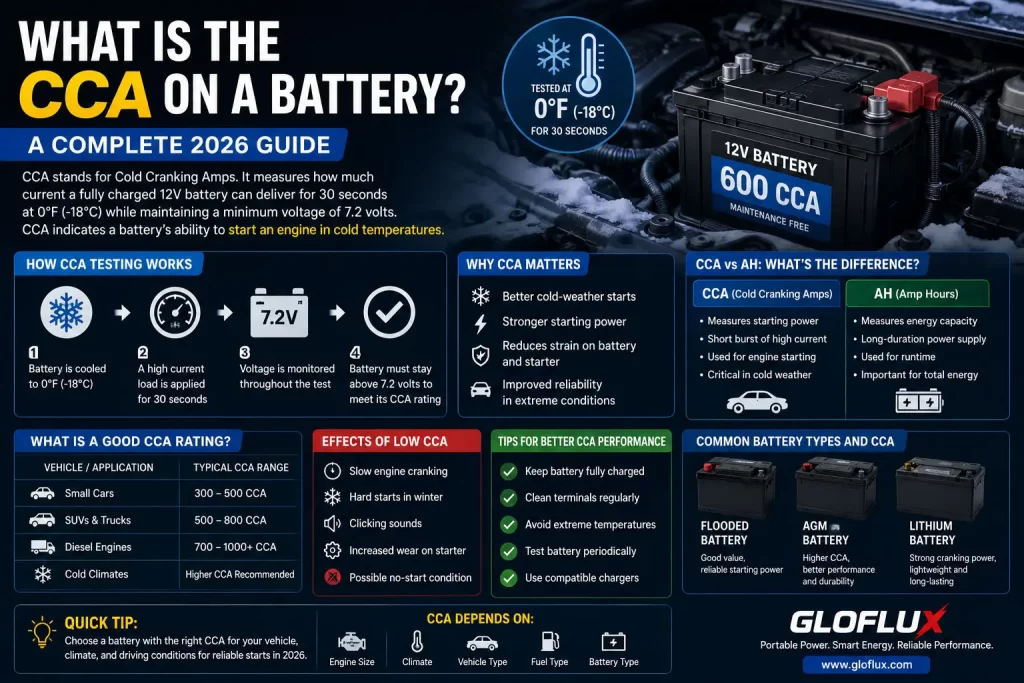
CCA stands for Cold Cranking Amps.
Cold Cranking Amps measure how much current a fully charged 12V battery can deliver for 30 seconds at 0°F (-18°C) while maintaining a minimum voltage of 7.2 volts.
In simple terms, CCA measures a battery’s ability to start an engine in cold temperatures.
The higher the CCA rating:
- The stronger the starting power
- The easier cold-weather engine starts become
- The better the battery performs under high-load starting conditions
CCA is mainly associated with:
- Batterie per avviamento automobilistico
- Truck batteries
- Batterie di avviamento marine
- Batterie per motociclette
- Generator batteries
- Heavy equipment batteries
Why Is CCA Important?
Cold weather dramatically affects battery performance.
As temperatures drop:
- Battery chemical reactions slow down
- Aumento della resistenza interna
- Available power decreases
- Engines require more energy to start
This creates a challenging situation where:
- The battery delivers less power
- The engine demands more power
CCA helps determine whether a battery can still provide enough current to crank the engine under these difficult conditions.
Without sufficient CCA, vehicles may experience:
- Slow cranking
- Partenze difficili
- Clicking sounds during ignition
- Complete starting failure in winter
How CCA Testing Works
Battery manufacturers use standardized testing procedures to determine CCA ratings.
During testing:
- The battery is cooled to 0°F (-18°C)
- A discharge load is applied for 30 seconds
- Voltage is monitored continuously
- The battery must remain above 7.2 volts
If the battery maintains sufficient voltage while delivering the rated current, it receives that CCA rating.
Ad esempio:
- A 600 CCA battery can supply 600 amps for 30 seconds at 0°F while staying above 7.2 volts
This testing method allows users to compare battery starting performance consistently across brands.
What Is a Good CCA Rating?
The ideal CCA depends on:
- Engine size
- Condizioni climatiche
- Vehicle type
- Fuel type
- Battery application
Small Cars
Smaller gasoline vehicles often require:
- 300–500 CCA
SUVs and Trucks
Larger vehicles commonly need:
- 500–800 CCA
Diesel Engines
Diesel engines generally require higher CCA because of increased compression resistance.
Many diesel systems use:
- 700–1000+ CCA
Cold Climates
Vehicles operating in colder regions usually benefit from higher CCA ratings.
In winter conditions, additional starting power becomes extremely important.
CCA vs Ah: What’s the Difference?
Many people confuse CCA with Ah (Amp Hours), but they measure completely different things.
| Specifiche | Misure | Scopo principale |
|---|---|---|
| CCA | Corrente di avviamento | Engine starting performance |
| Ah | Energy capacity | Runtime and energy storage |
CCA Focuses On:
- Short-term high-current delivery
- Engine cranking performance
- Cold-weather starts
Ah Focuses On:
- Long-duration energy storage
- Durata
- Continuous power supply
Ad esempio:
- A starter battery prioritizes CCA
- A solar battery prioritizes Ah
Understanding this distinction helps users select the correct battery type for their application.
Does Higher CCA Mean Better Battery Performance?
Not always.
A higher CCA rating improves cold-weather starting capability, but that does not necessarily mean the battery stores more energy or lasts longer.
Higher CCA mainly benefits:
- Cold-weather reliability
- Large engines
- High-compression systems
- Heavy-duty starting conditions
For lightweight portable electronics or energy storage systems, Ah and battery chemistry may matter more than CCA.
Can You Use a Battery with Higher CCA?
In most cases, yes.
Using a battery with higher CCA than the minimum requirement generally does not damage the vehicle.
The starter motor only draws the current it needs.
Benefits of higher CCA may include:
- Easier cold starts
- Reduced stress during ignition
- Improved winter reliability
- Better performance as the battery ages
However, the battery must still match:
- Voltage requirements
- Dimensioni fisiche
- Terminal layout
- Compatibilità di ricarica
What Happens If CCA Is Too Low?
Insufficient CCA can create several problems.
Common Symptoms
- Slow engine turnover
- Hard starting in winter
- Weak ignition performance
- Battery strain
- Increased starter motor stress
In severe cases, the engine may fail to start completely.
Cold weather often exposes weak batteries because reduced chemical activity lowers available output power.
Does Battery Chemistry Affect CCA?
Yes. Different battery chemistries perform differently under high-load starting conditions.
Batterie al piombo-acido
Traditional lead-acid batteries commonly use CCA ratings because they are designed primarily for engine starting applications.
Questi includono:
- Flooded batteries
- Batterie AGM
- Enhanced flooded batteries (EFB)
Batterie al litio
Modern lithium batteries behave differently.
Many lithium batteries:
- Maintain voltage more effectively
- Provide strong discharge efficiency
- Recupero più velocemente dopo l'uso
- Offer lightweight construction
Some lithium starter batteries include CCA ratings, while others focus more on:
- Continuous discharge current
- Peak current output
- Watt-hour capacity
- Battery Management System (BMS) performance
A Gloflux, lithium battery systems are increasingly used for portable energy applications where energy density, portability, and efficiency are major priorities.
How Temperature Impacts Battery Performance
Temperature plays a massive role in battery behavior.
Cold Temperatures
Cold weather:
- Reduces battery chemical activity
- Increases oil viscosity in engines
- Raises internal resistance
- Decreases available current output
This is why winter conditions require stronger starting power.
Temperature elevate
Hot weather may temporarily improve starting performance, but excessive heat accelerates battery aging and internal degradation.
AGM vs Flooded Batteries for CCA
AGM (Absorbent Glass Mat) batteries often provide higher CCA ratings compared to traditional flooded batteries of similar size.
AGM Advantages
- Better vibration resistance
- Improved cold-weather performance
- Faster recharge acceptance
- Lower maintenance requirements
These features make AGM batteries popular in modern vehicles with higher electrical demands.
Why CCA Still Matters in 2026
Although electric vehicles continue growing, internal combustion engines still dominate many markets worldwide.
CCA remains important for:
- Cars and trucks
- Hybrid vehicles
- Sistemi marini
- Generatori
- Commercial fleets
- Sistemi di alimentazione di riserva
At the same time, portable energy markets are evolving rapidly.
Modern battery users increasingly prioritize:
- Accumulo energetico leggero
- Portable lithium systems
- Ricarica rapida
- Smart battery management
- Reliable low-temperature performance
As a result, battery manufacturers continue improving both traditional starting batteries and advanced lithium technologies.
Battery Maintenance Tips for Better CCA Performance
Proper maintenance helps preserve battery starting power over time.
Keep the Battery Fully Charged
Undercharged batteries lose available cranking power.
Clean Battery Terminals
Corrosion increases resistance and reduces power delivery.
Evitare temperature estreme
Excessive heat and freezing conditions accelerate battery degradation.
Test the Battery Regularly
Periodic battery testing helps identify declining CCA before complete failure occurs.
Usa caricabatterie compatibili
Improper charging can shorten battery lifespan and reduce starting performance.
Choosing the Right Battery in 2026
When selecting a battery, buyers should consider:
- Required CCA
- Runtime requirements
- Condizioni climatiche
- Chimica delle batterie
- Compatibilità di ricarica
- Device power demand
- Portability needs
For engine-starting applications, CCA remains one of the most important specifications.
For portable electronics and energy storage systems, users may prioritize:
- Ah capacity
- Densità energetica
- Ricarica rapida
- Progettazione leggera
A Soluzioni per batterie Gloflux, we continue focusing on modern portable battery technologies that support evolving energy demands across consumer and industrial markets.
The Future of Battery Starting Technology
Battery technology continues advancing rapidly.
Future trends include:
- Smarter BMS systems
- Improved low-temperature lithium performance
- Faster charging capability
- Densità energetica più alta
- Portable modular battery systems
- Advanced thermal management
Even as battery chemistry evolves, reliable starting power will remain critical across transportation and backup power applications.
Considerazioni finali
CCA measures a battery’s ability to deliver strong starting current under cold-weather conditions. It remains one of the most important specifications for automotive, marine, and generator batteries in 2026.
Higher CCA ratings improve:
- Cold-weather starts
- Starting reliability
- Heavy-load engine cranking
However, CCA is only one part of battery selection. Buyers should also consider runtime, battery chemistry, charging efficiency, portability, and long-term application needs.
Understanding how CCA works helps users choose safer, more reliable, and better-performing battery systems for both traditional and modern energy applications.
For more battery insights and portable energy solutions, visit Sito ufficiale di Gloflux.
FAQ About Battery CCA
What does CCA mean on a battery?
CCA stands for Cold Cranking Amps, which measures a battery’s ability to start an engine in cold temperatures.
Is higher CCA better?
Higher CCA improves cold-weather starting performance, especially for larger engines and colder climates.
Can a battery have too much CCA?
Generally no. A higher CCA battery usually works fine if voltage and physical compatibility match the vehicle.
Does CCA affect runtime?
No. CCA measures starting power, while runtime depends more on Ah capacity.
Are lithium batteries rated in CCA?
Some lithium starter batteries use CCA ratings, while others focus on discharge current and energy capacity instead.
Parla con il produttore
Risorse e approfondimenti
La migliore batteria LiPo per dispositivi IoT: come scegliere la soluzione di alimentazione giusta
2026-07-28
Pacco batterie al litio personalizzato 51.8V 30Ah 21700 per sistemi di alimentazione robotici umanoidi commerciali con BMS integrato per un funzionamento sicuro e affidabile
2026-07-28
Modulo batteria LiFePO4 personalizzato da 38,4V 30Ah per robot con porta di ricarica wireless
2026-07-28
24V 36V 48V 52V 60V 72V 40Ah 50Ah LiFePO4 Batteria ricaricabile per camper, AGV, golf cart e sistemi di accumulo energetico
2026-07-28


